Full Stack Development

A full stack developer understands the complete application lifecycle—from designing responsive user interfaces to building robust backend services, storing and managing data, and deploying applications to production. This versatility enables them to handle end-to-end development efficiently and collaborate effectively across different stages of software development

Average Salary Package: ₹5,00,000 P.A to ₹28,00,000 P.A

Live Projects
Certification
Placement Assistance
Expert Mentors
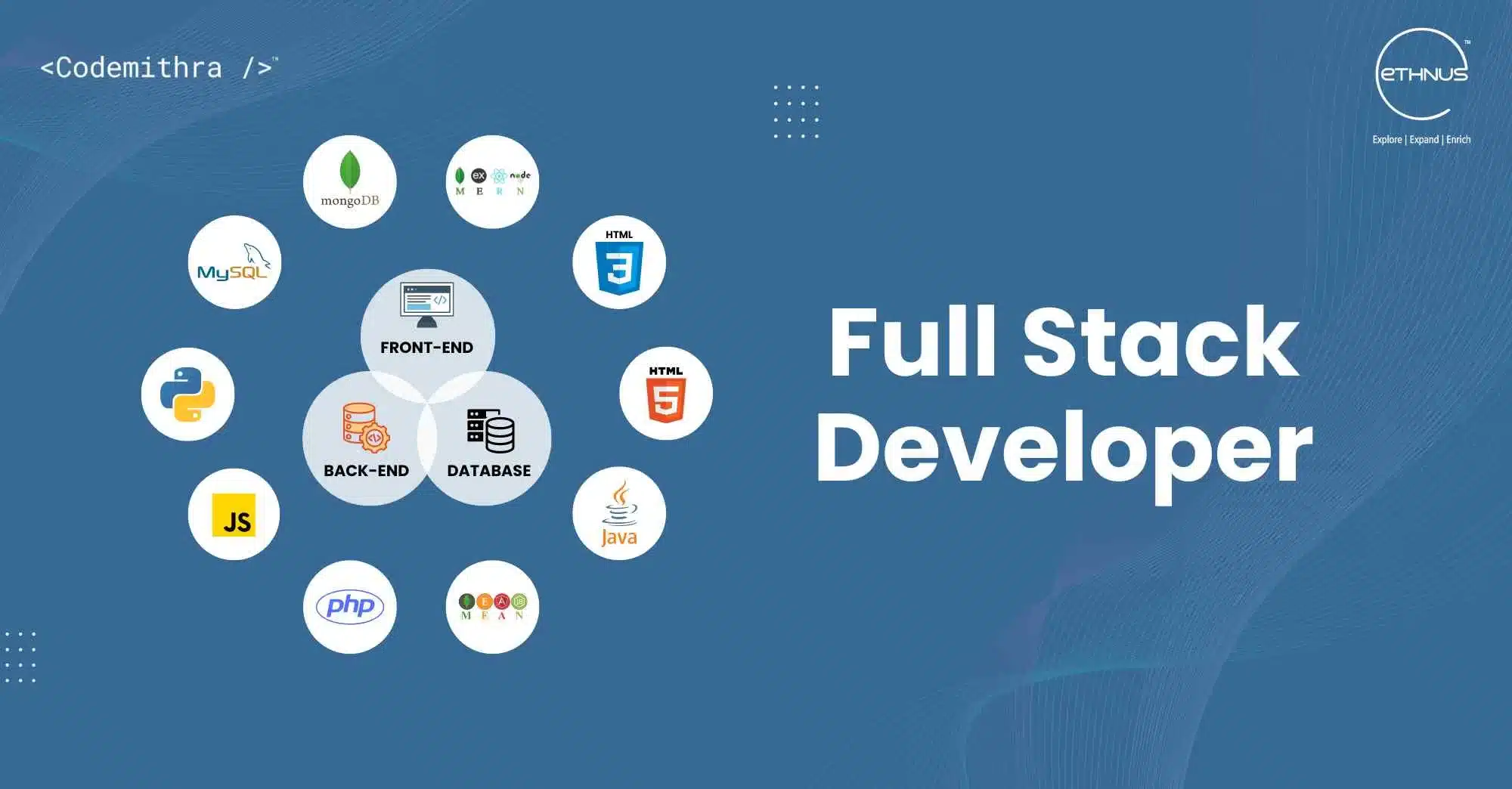
Full Stack Development

Full Stack Development

Full Stack Development refers to the process of building both the frontend (client-side) and the backend (server-side) of a web application. A Full Stack Developer is responsible for creating the user interface, writing server-side logic, managing databases, integrating APIs, implementing authentication, and deploying the application.

A complete full-stack application consists of:

  • Frontend (React, Angular, Vue)

  • Backend (Node.js, Laravel, Django, Spring Boot)

  • Database (MongoDB, MySQL, PostgreSQL)

  • API Layer (REST or GraphQL)

  • Authentication

  • Deployment

A Full Stack Developer understands how all these components communicate with each other.

The frontend communicates with the backend using HTTP requests. When a user performs an action, such as clicking a button or submitting a form, the frontend sends a request to the backend API.

The backend processes the request, interacts with the database if required, and sends a response, usually in JSON format. The frontend then updates the user interface based on that response.

Common HTTP methods include:

  • GET

  • POST

  • PUT

  • PATCH

  • DELETE

When a user enters a URL, several steps occur before the webpage is displayed.

  1. The browser checks its cache.

  2. A DNS lookup converts the domain name into an IP address.

  3. The browser establishes a TCP connection.

  4. An HTTPS handshake is performed if the website uses SSL/TLS.

  5. The browser sends an HTTP request.

  6. The web server processes the request.

  7. The backend retrieves data if necessary.

  8. The server sends an HTTP response.

  9. The browser downloads HTML, CSS, and JavaScript.

  10. The page is rendered on the screen.

A REST API (Representational State Transfer) is a set of architectural principles for building web services. It allows different applications to communicate over HTTP using standard methods such as GET, POST, PUT, PATCH, and DELETE.

REST APIs are stateless, meaning each request contains all the information needed to process it. They commonly exchange data in JSON format, making them suitable for communication between frontend applications and backend servers.

Authentication verifies the identity of a user, while authorization determines what that authenticated user is allowed to access.

A common workflow is:

  1. The user submits login credentials.

  2. The server validates the credentials.

  3. A JWT or session is created.

  4. The client stores the token securely.

  5. The client sends the token with future requests.

  6. The server validates the token before allowing access to protected resources.

Authorization then checks the user's role or permissions before performing restricted actions.

CORS (Cross-Origin Resource Sharing) is a browser security mechanism that controls whether a webpage can make requests to a different domain, protocol, or port.

Without proper CORS configuration, browsers block cross-origin requests to protect users from malicious websites.

For example, if a React application runs on http://localhost:3000 and the backend API runs on http://localhost:5000, the backend must explicitly allow requests from the frontend.


JWT (JSON Web Token) is a compact, URL-safe token used for authenticating users in stateless applications.

After a successful login, the server generates a signed JWT and sends it to the client. The client includes this token in the Authorization header for future requests.

The server verifies the token before granting access to protected routes. Since JWT contains user information and is digitally signed, it removes the need to store session data on the server.

Client-Side Rendering (CSR) generates the HTML in the browser using JavaScript after the initial page load. Frameworks like React typically use CSR.

Server-Side Rendering (SSR) generates the HTML on the server before sending it to the browser. Frameworks such as Next.js support SSR.

CSR often provides smoother interactions after loading but may have slower first-page rendering. SSR usually delivers faster initial page loads and improved SEO because search engines receive fully rendered HTML.

Performance optimization should address every layer of the application.

On the frontend:

  • Lazy loading

  • Code splitting

  • Image optimization

  • Caching

  • Minification

On the backend:

  • Efficient database queries

  • Pagination

  • Caching (Redis)

  • Background jobs

  • Compression

  • Connection pooling

On the database:

  • Proper indexing

  • Query optimization

  • Avoid unnecessary joins or lookups

  • Normalize or denormalize data where appropriate

Infrastructure improvements include:

  • CDN

  • Load balancer

  • Auto-scaling

  • Monitoring

A scalable full-stack application should have a clear separation of responsibilities and be designed to handle increasing traffic without major architectural changes.

A common architecture includes:

  • React for the frontend

  • Node.js or Laravel for the backend

  • MongoDB or MySQL for data storage

  • Redis for caching

  • JWT or OAuth for authentication

  • Background queues for long-running tasks

  • Docker for containerization

  • Nginx as a reverse proxy

  • Cloud deployment (AWS, Azure, or GCP)

  • CI/CD pipeline for automated deployment

  • Monitoring and logging tools

This architecture allows individual components to scale independently and improves maintainability.

API Versioning is the practice of maintaining multiple versions of an API so that existing applications continue to work even after new features or changes are introduced.

Without versioning, modifying an existing API could break mobile apps, web applications, or third-party integrations that depend on the current response format.

The most common approaches are:

  • URL Versioning (/api/v1/users)

  • Header Versioning

  • Query Parameter Versioning

Versioning ensures backward compatibility and allows developers to improve APIs without affecting existing clients.

GraphQL is a query language for APIs that allows clients to request exactly the data they need instead of receiving a fixed response.

Unlike REST, where multiple endpoints may be required to fetch related data, GraphQL often retrieves everything through a single endpoint.

GraphQL is a good choice for applications with complex data requirements, such as dashboards, social media platforms, and mobile apps where reducing network requests is important.

REST is often preferred for simpler CRUD applications because it is easier to implement and widely adopted.

A WebSocket is a communication protocol that provides a persistent, two-way connection between the client and the server.

Unlike HTTP, where a new request is required for every interaction, WebSockets keep the connection open, allowing the server to push updates instantly.

WebSockets are commonly used for:

  • Chat Applications

  • Live Notifications

  • Online Gaming

  • Stock Market Updates

  • Live Dashboards

  • Collaborative Editing

A Load Balancer distributes incoming user requests across multiple application servers instead of sending all traffic to a single server.

This prevents one server from becoming overloaded and improves performance, scalability, and availability.

If one server fails, the Load Balancer automatically routes requests to healthy servers, ensuring minimal downtime.

Popular Load Balancers include:

  • Nginx

  • HAProxy

  • AWS Elastic Load Balancer

Docker is a containerization platform that packages an application along with its dependencies into a container.

This ensures that the application behaves the same way across development, testing, and production environments.

Docker eliminates the common problem of "it works on my machine" because every environment runs the same container.

It is commonly used for deploying:

  • React Applications

  • Node.js APIs

  • Laravel Applications

  • Databases

  • Redis

  • Nginx

CI/CD stands for Continuous Integration and Continuous Deployment (or Continuous Delivery).

Continuous Integration automatically builds and tests code whenever developers push changes to the repository.

Continuous Deployment automatically deploys tested code to production or staging environments.

CI/CD helps teams:

  • Detect bugs early

  • Automate testing

  • Reduce deployment errors

  • Deliver features faster

  • Improve code quality

Popular CI/CD tools include GitHub Actions, GitLab CI/CD, Jenkins, Azure DevOps, and CircleCI.

Ready to Transform Your Business?

Let's discuss how we can help you achieve your goals. Book a free 30-minute strategy call with our experts.

Free Consultation
30-minute strategy call
Quick Response
Reply within 24 hours
No Commitment
Free quote & proposal
Available now
No credit card required 100% satisfaction guarantee